 Request a callback
 Call us now 01902 504 411

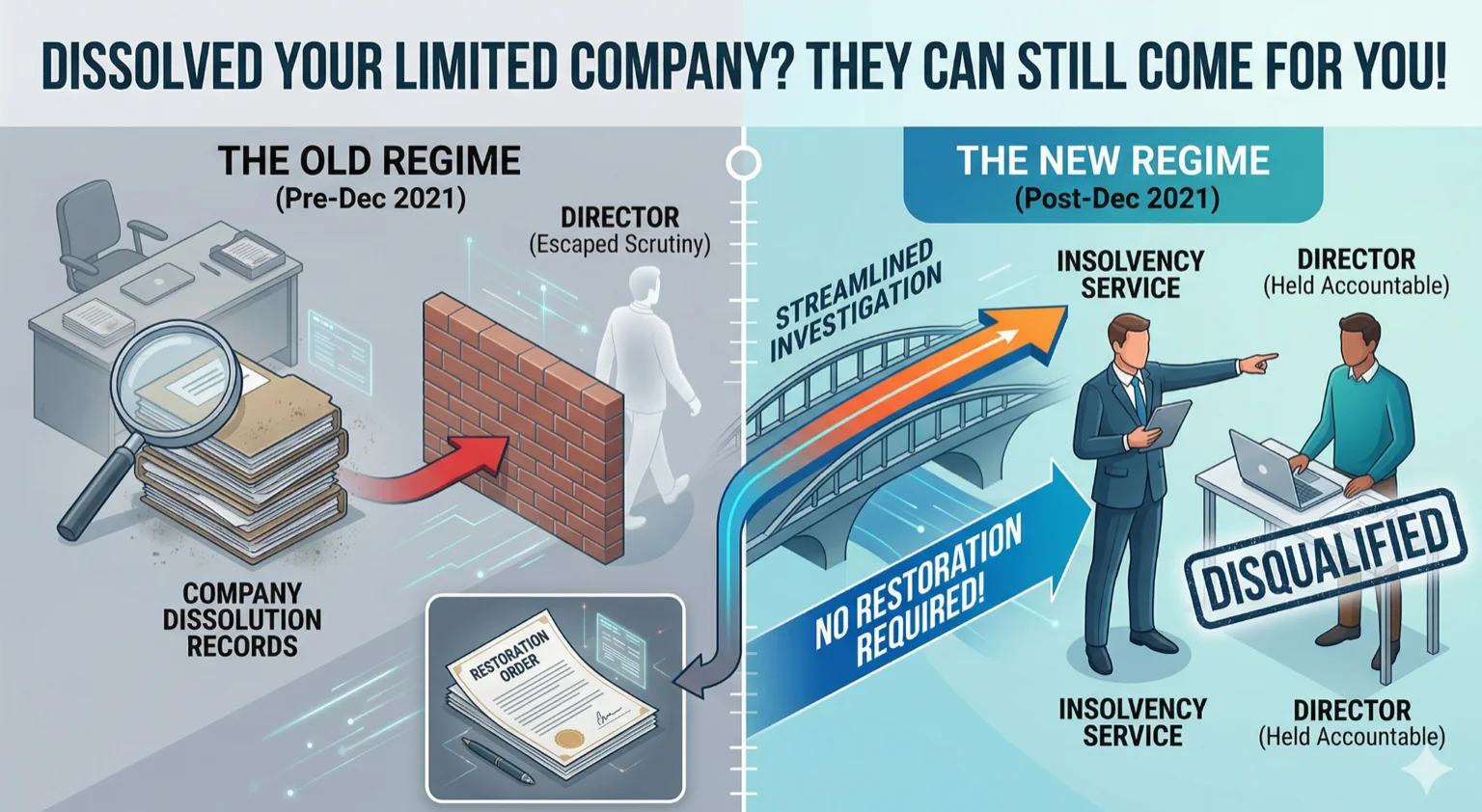
A director of a dissolved company can still be disqualified. In fact, in recent years, this has become significantly easier for the Insolvency Service to pursue. The law relating to director disqualification has shifted significantly to prevent directors from using dissolution as a tactical tool. Some directors often use a company's dissolution to escape scrutiny of their conduct and potential liability, including disqualification.
The Old Regime
Prior to December 2021, the Company Directors Disqualification Act 1986 ('CDDA 1986') only permitted the Insolvency Service to investigate the conduct of directors and former directors of companies that remained on the register of companies (at Companies House) and/or were going through an insolvency process. Historically, directors of dissolved companies could only be investigated if the company was restored to the company register — a costly and time-consuming step that often deterred action. However, that required step and previous barrier have now been removed, enabling direct investigation and disqualification of a director without the need to restore the company.
Dissolution Offered Protection From Disqualification — No Longer the Position
Circumstances largely drove the desire to change the old regime. During the COVID-19 pandemic, many companies received government assistance loans. However, some directors then sought to dissolve their companies in a deliberate effort to avoid scrutiny, sidestep accountability for any misconduct, and evade repaying the loans their companies had received altogether. Going through the dissolution process provided directors with a "cloak of security — some argue invincibility", knowing that under the provisions of the CDDA they could not be disqualified.
The New Regime
Attributable to the above reasons, the Rating (Coronavirus) and Directors Disqualification (Dissolved Companies) Act 2021 ('the Act') received Royal Assent on 15 December 2021, with the majority of its provisions coming into force from 15 February 2022. The Act implements changes to the CDDA 1986. The most important and vital amendments are:
- The Insolvency Service can now investigate the misconduct of directors of dissolved companies without the company first having to be restored to the register of companies.
- Removing this previous barrier now places dissolved companies on the same footing as insolvent ones for director accountability. Directors of dissolved companies are just as likely to be disqualified as directors of insolvent companies.
- The changes now explicitly allow the court to disqualify a person who "has been a director of a company which has at any time been dissolved without becoming insolvent, and whose conduct makes them unfit to be a director of a limited company".
Why This Matters for Creditors and the Public
Under the old regime, directors utilised a barrier as a deliberate attempt to prevent their misconduct from being investigated. That barrier has now been removed, providing a mechanism and route for both creditors and the general public to challenge any misconduct by a director. This also strengthens public confidence in the corporate system by ensuring directors cannot simply dissolve a company to avoid accountability.
Concerns can be made directly to the Insolvency Service, which now has the authority and legal standing to investigate dissolved companies. Crucially, the Act applies retrospectively, allowing the Insolvency Service to exercise its new powers in relation to companies that were dissolved before the legislation came into force.
If You Are a Director, Don't Wait for the Letter
If you have dissolved a company and there are outstanding liabilities, unresolved creditor disputes, or conduct that could attract scrutiny, the time to take advice is now — not when the Insolvency Service writes to you. By that point the investigation is already underway and your options have narrowed. At D&N Solicitors, we work with directors who need honest, strategic guidance on their exposure and their next move. If you have received a Section 16 notice, are worried about your duties as a director, or are simply unsure whether any of this applies to you, contact us for a confidential consultation before the decision is taken out of your hands.
Frequently Asked Questions
Can I still be disqualified if my limited company has already been dissolved?
Yes. Since 15 February 2022, following the Rating (Coronavirus) and Directors Disqualification (Dissolved Companies) Act 2021, the Insolvency Service can investigate the conduct of former directors of a dissolved company without first needing to restore the company to the register at Companies House. Directors of dissolved companies are now on the same footing as directors of insolvent companies for disqualification purposes.
Does the new dissolved-company disqualification law apply retrospectively?
Yes. The Act applies retrospectively, meaning the Insolvency Service can exercise its powers in relation to companies that were dissolved before the legislation came into force on 15 February 2022. If you dissolved a company with outstanding creditor disputes or Bounce Back Loan exposure pre-2022, the Insolvency Service can still investigate and pursue disqualification proceedings.
What should I do if I think my conduct as a former director could be investigated?
Take advice before a Section 16 notice arrives. Once the Insolvency Service writes to you, the investigation is already underway and your options have narrowed. Early engagement with a specialist director-disqualification solicitor lets you assess exposure, prepare a strategy, and — where appropriate — make representations that can persuade the Insolvency Service to stop short of formal proceedings.