

What Legislation Should I Be Aware Of?
The Company Directors Disqualification Act 1986 ('CDDA 1986') sets out the framework for and is the primary legislation governing Director Disqualification Proceedings ('Disqualification Proceedings').
What Time Limits Should I Be Aware Of, and What Happens If I Miss Them?
In 2015, the rules governing the time limit for issuing Disqualification Proceedings changed. At the time of this article, the Secretary of State for the Department of Business and Trade ('the SOS') has three years from the date of insolvency to issue Disqualification Proceedings against directors of insolvent companies they deem unfit to be a director.
For example, if Imagine Limited entered Creditors' Voluntary Liquidation on 5th January 2026, the SOS would have until 4th January 2029 to issue Disqualification Proceedings against its director(s). However, the reader should be aware that the SOS does not often leave the issue of Disqualification Proceedings until the last moment.
If the time limit passes, the SOS is prohibited from commencing Disqualification Proceedings unless the court grants leave. However, the SOS's failure to meet strict deadlines often results in missed opportunities to bring such proceedings, which are no longer available to them.
What Is a Section 16 Notice ('S16') and What Is Usually Contained Within It?
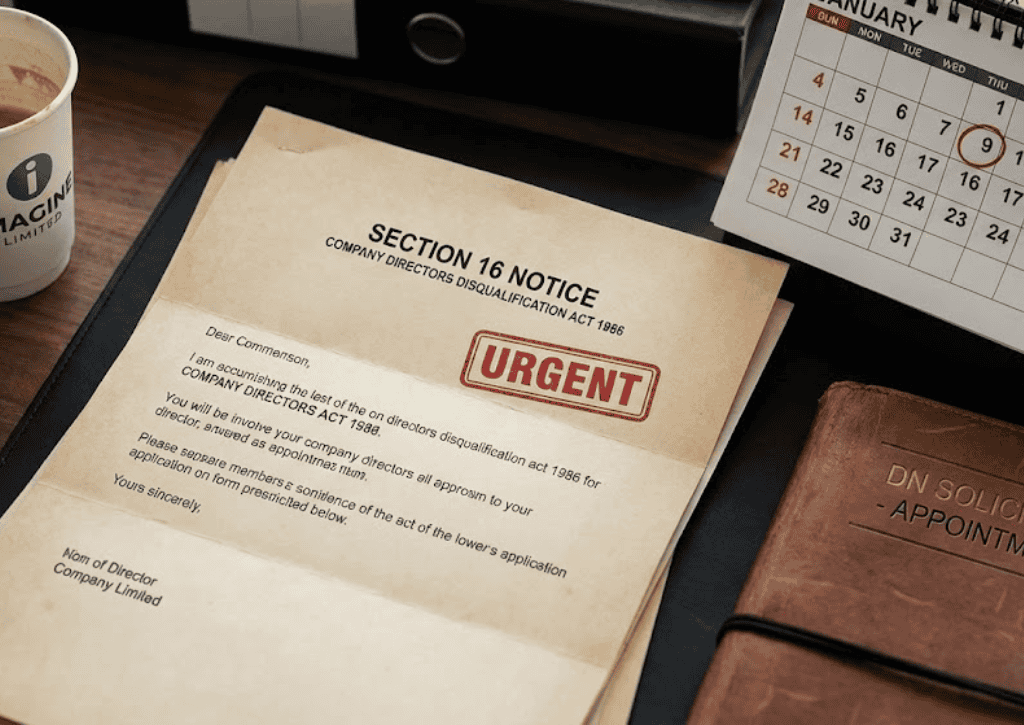
An S16 is issued under the CDDA 1986 and is a formal notice usually sent by the Insolvency Service to a director by letter. It contains, sets out and informs the director of the following:
- Makes reference to S16 of the CDDA 1986, usually in the subject line of the letter in bold and capital letters.
- The SOS's intention is to issue Disqualification Proceedings following the conclusion of its investigation into the director's conduct.
- The S16 must be sent to a director at least 10 days before any Disqualification Proceedings are issued. This enables the director to review their options, seek independent legal advice, and resolve the matter by agreeing to sign a Disqualification Undertaking, removing the need to issue proceedings.
- A summary of the allegations and alleged misconduct by the director. For example, trading whilst insolvent, false Bounce Back Loan ('BBL') application made, misapplication of BBL funds, failure to maintain the company's books and records, non-payment of HMRC liabilities or abuse of the company's Directors' Loan Account.
- The period of disqualification being sought. This usually falls into three bands and is subject to the seriousness of the allegations being pursued:
- 2 to 5 years – usually classified as the lower bracket
- 6 to 10 years – usually classified as the middle bracket
- 11 to 15 years – usually classified as the higher bracket
- The SOS also usually provides a booklet or other reading material on Disqualification Proceedings, the process and procedures, and the S16.
- Information regarding the director's ability to provide a Disqualification Undertaking and a copy of the Disqualification Undertaking itself for the director's consideration.
- The S16 will also confirm whether the SOS is seeking a Compensation Order against the director alongside disqualification.
What Should You Do, and How Can We Assist You?
Receiving an S16 can be particularly frightening. However, all is not lost. This firm regularly works with clients once they have received an S16. This firm has a track record of persuading the SOS to move from its position to not only reduce the original period of disqualification sought, but also terminate its investigation into the director altogether.
If you have been sent an S16, it is important to undertake the following steps:
- Do not panic. Help is available to you.
- Do not ignore the S16 and immediately seek legal assistance.
- The S16, although it appears to be a final determination by the SOS, is not. There are still options available to you, including filing submissions and attending a meeting with the SOS.
- With the assistance of this firm, a plan, strategy, and the best way to defend your position can be reviewed, discussed, and agreed upon with you. This includes exploring the benefits of attending a meeting with the SOS, which can and is usually highly persuasive in convincing the SOS to terminate its investigation.
It is important to note that each director's position, profession, age, health, job prospects, and life experiences differ from those of other directors. Therefore, each strategy for addressing the S16 depends on the director's individual needs, as each case is different and has its own complexities.
If you have any queries regarding the above, please do not hesitate to contact us. We will be happy to assist.